
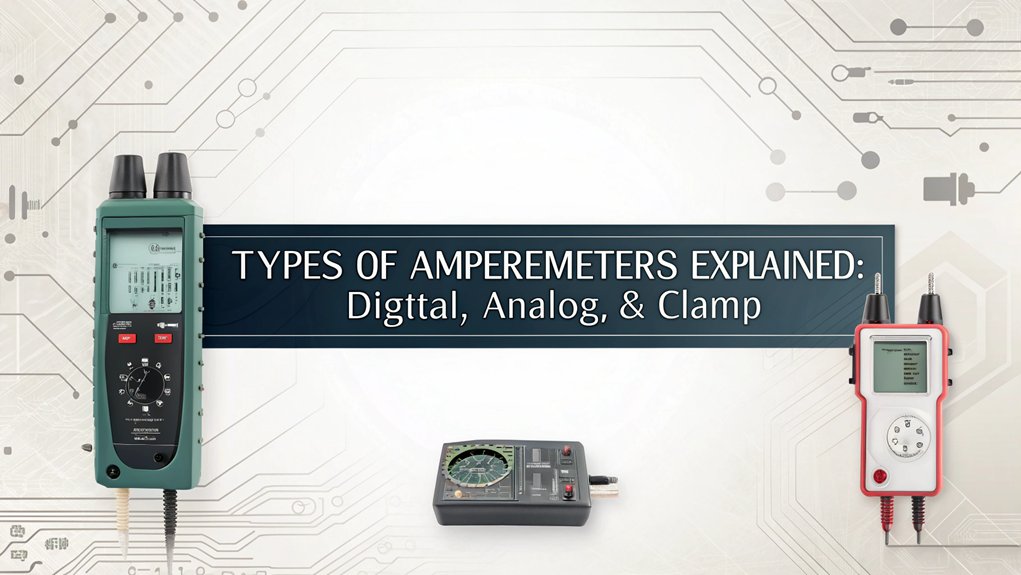
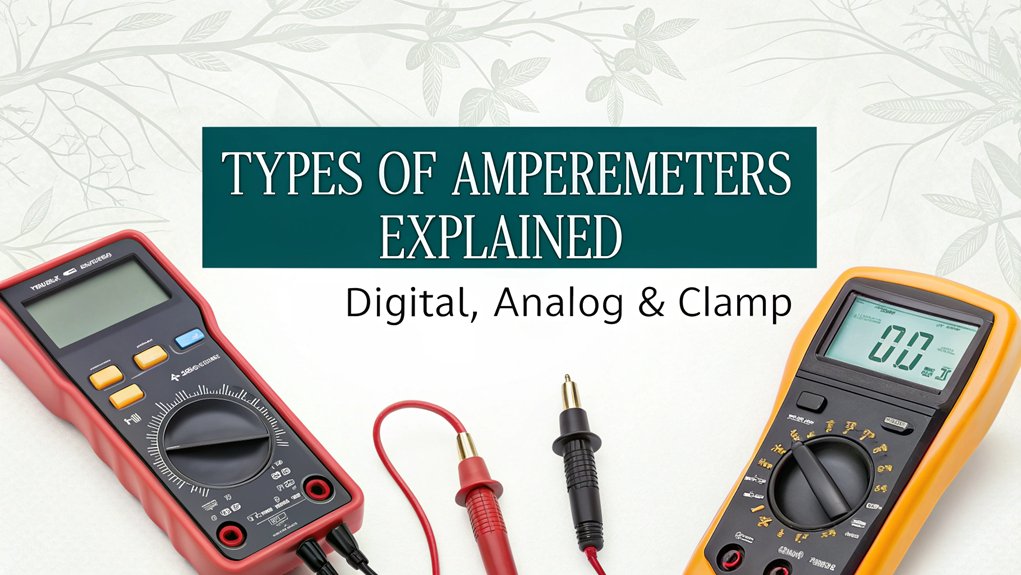
Discover the distinctions among digital, analog, and clamp amperemeters. Digital amperemeters offer precision and readability with digital displays and programmable features. Analog variants, such as moving iron and coil meters, remain reliable for AC/DC, primarily excelling in DC measurements. Clamp meters enable non-invasive current measurement through magnetic field detection, excelling in AC with options like Hall Effect for both AC and DC. Explore further insights to pinpoint which amperemeter best suits your technical requirements.
TLDR
- Digital amperemeters offer precise measurements and programmable features for alarms and messages.
- Analog amperemeters use needle and dial displays and excel in reliability.
- Clamp amperemeters provide non-intrusive current measurement using magnetic field detection.
- Moving coil ammeters are ideal for measuring direct current with high accuracy.
- True RMS functionality in digital models ensures accuracy with complex waveform measurements.
Understanding Amperemeters
Amperemeters, essential tools for measuring electric current, play a significant role in electrical diagnostics and maintenance. Understanding the types of amperemeters is important for precise current measurements.
Analog ammeters, with their needle and dial system, provide a straightforward method to gauge electrical current, offering reliability in various applications. Digital ammeters, however, deliver enhanced visibility and precision, crucial in industrial settings.
Meanwhile, clamp-on ammeters offer a non-invasive solution by allowing you to measure current without circuit disconnection, thereby simplifying troubleshooting processes. This versatility is indispensable when precision is paramount.
For low current applications, specialized versions like milliammeters and microammeters guarantee accurate readings. Whether you’re working in complex industrial environments or straightforward maintenance, selecting the appropriate amperemeter type optimizes your measuring strategy.
Digital Amperemeters
While offering enhanced precision and ease of readability, digital ammeters stand as a cornerstone in modern electrical diagnostics. They excel by providing current readings on a digital panel, surpassing analog models in user convenience, particularly in low-light conditions.
You’ll find them indispensable in industrial settings where complex electrical systems demand precise measurements. Programmable features allow you to set alarms and messages based on specific current levels, enhancing your monitoring capabilities.
Auto-ranging technology simplifies your task by automatically selecting the correct measurement range. Digital ammeters accommodate various operating temperatures, ensuring reliability across diverse environments.
Their ease of use and ability to handle extensive amp measurement ranges make them a preferred choice for professionals seeking accuracy and efficiency in electrical diagnostics.
Analog Amperemeters
Analog amperemeters, traditional yet reliable instruments, offer a tangible way to monitor electrical currents in circuits through a needle and dial display. In industrial settings, you’ll find various types of analog ammeters, each suited for specific applications. Moving iron ammeters are versatile, measuring both AC and DC current, ideal for broad applications. Moving coil ammeters excel in DC current measurements, utilizing magnetic fields for enhanced sensitivity and accuracy. Electrodynamic ammeters, robust in nature, handle both AC and DC currents, accommodating larger current ranges efficiently. Here’s a quick comparison:
| Type | Current Type |
|---|---|
| Moving Iron | AC, DC |
| Moving Coil | DC |
| Electrodynamic | AC, DC |
These devices guarantee precision in current measurements across diverse environments.
Clamp Amperemeters
Though often overlooked, clamp amperemeters offer a sophisticated approach to measuring electrical currents without disrupting the circuit.
These clamp meters leverage non-invasive measurements, utilizing a clamp mechanism to detect the magnetic field around conductors. For AC measurement, current transformer clamp meters are ideal, while Hall Effect clamp meters handle both AC/DC.
Opt for advanced clamp meters with True RMS capability to guarantee precise readings on non-linear loads. Flexible current options allow you to maneuver easily in confined spaces.
Some models even feature a detachable display, enhancing usability in complex environments. When measuring current, consider the application’s specific needs, focusing on measurement range and additional functionalities like voltage and resistance measurement for thorough diagnostics and troubleshooting.
Key Differences Between Types
Understanding the key differences between types of amperemeters is essential for selecting the right tool for your electrical measurements.
Digital multimeters offer a clear measurement display, advantageous in low light, and feature capabilities such as data logging and programmable alarms.
In contrast, analogue ammeters employ a needle and dial, lacking these advanced functionalities.
Clamp meters excel in non-intrusive current measurement, eliminating the need to disrupt the electrical circuit. They can handle both AC and DC currents, unlike certain analogue ammeters which are restricted to specific current types.
True RMS functionality is another critical distinction, providing accurate readings in complex waveforms.
Each type addresses specific applications, so understanding these differences guarantees you select the most effective tool for precise current analysis.
Choosing the Right Amperemeter
How do you guarantee you’ve selected the right amperemeter for your needs? Begin by determining whether you’ll measure alternating current or direct current.
Digital ammeters excel in low light conditions, while analog ammeters offer a visual current flow representation. For non-intrusive measurements in live circuits, choose a clamp-on ammeter.
Assess the measurement range and accuracy specifications to align with your electrical applications. For specialized tasks like measuring minute currents, milliammeters or microammeters provide precision.
Don’t overlook the ammeter’s safety ratings—Cat III or Cat IV provide protection in hazardous environments.
Each attribute, from accuracy to safety, plays an essential role in confirming the amperemeter fits your specific needs, facilitating reliable and efficient current measurement.
Frequently Asked Questions
What Are the Three 3 Types of Clamp Meters That Exist?
You’ll encounter three main types of clamp meters: Current Transformer, Hall Effect, and Flexible.
Current Transformer clamp meters are cost-effective, ideal for basic AC measurements.
Hall Effect clamp meters offer precision for both AC and DC, though they’re pricier due to advanced technology.
Flexible clamp meters excel in confined spaces with their adaptable coils, measuring primarily AC.
Each type efficiently detects magnetic fields, ensuring safe, non-intrusive current assessment.
What Are the Different Types of Current Clamps?
When you’re analyzing different types of current clamps, you need to take into account Current Transformer, Hall Effect, and Flexible clamp meters.
Current Transformer clamps are ideal for AC measurements due to their cost-effectiveness.
Hall Effect clamps offer versatility, measuring both AC and DC with advanced accuracy, but they come at a higher price.
Flexible clamps accommodate tight spaces, primarily for AC measurements, enhancing your troubleshooting efficiency.
Understanding these distinctions optimizes your measurement strategy.
What Are the Different Types of Analog Ammeters?
You’re exploring the types of analog ammeters, which include moving iron, moving coil, electrodynamic, and hot wire ammeters.
Moving iron ammeters measure AC/DC currents robustly.
Moving coil ammeters are precise for DC currents, using magnetic fields.
Electrodynamic ammeters handle both AC and DC with high accuracy, ideal for labs.
Hot wire ammeters measure current via heat, useful in specific thermal applications.
Each type suits distinct applications, enhancing your measurement precision.
What Is the Difference Between a Clamp Meter and a Digital Multimeter?
When you compare a clamp meter with a digital multimeter, think of the legendary Excalibur versus a Swiss Army knife.
The clamp meter, like Excalibur, specializes in non-invasive current measurement. It excels at handling high currents without breaking circuits.
Meanwhile, the digital multimeter, akin to a Swiss Army knife, offers versatility, measuring voltage, resistance, and current with precision.
Each tool has its forte, tailored for specific electrical tasks and analyses.
Conclusion
As you navigate the labyrinth of amperemeter types—digital, analog, and clamp—you’ll find the perfect fit is no accident. It’s a precise alignment of your technical demands with each tool’s unique capabilities. Whether you need the digital precision, the analog’s classic reliability, or the clamp’s versatile embrace, the right choice coincides with your specific needs. Each amperemeter is a key, facilitating accurate current measurement in its own distinctive way, seamlessly integrating into your electrical toolkit.