
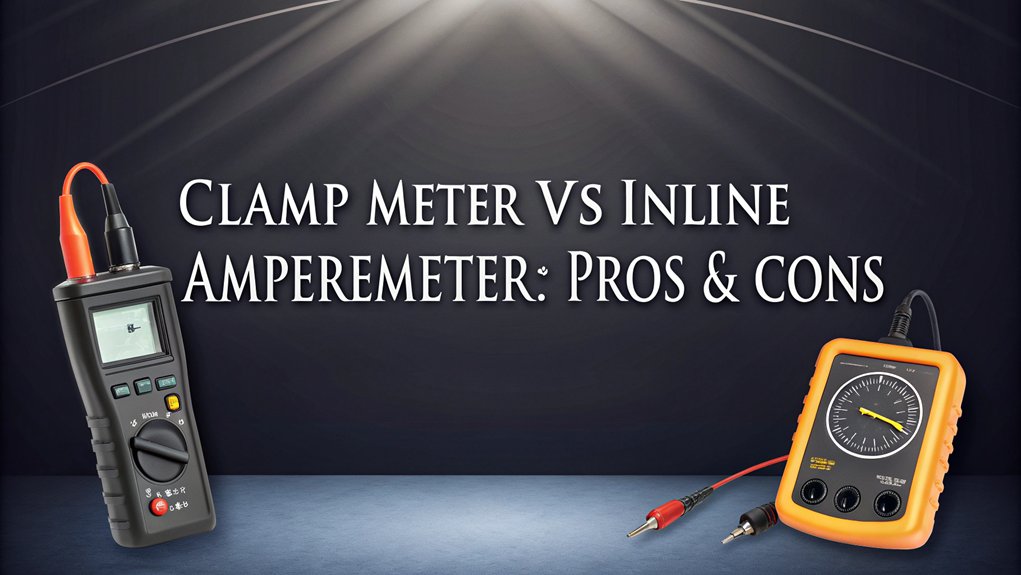
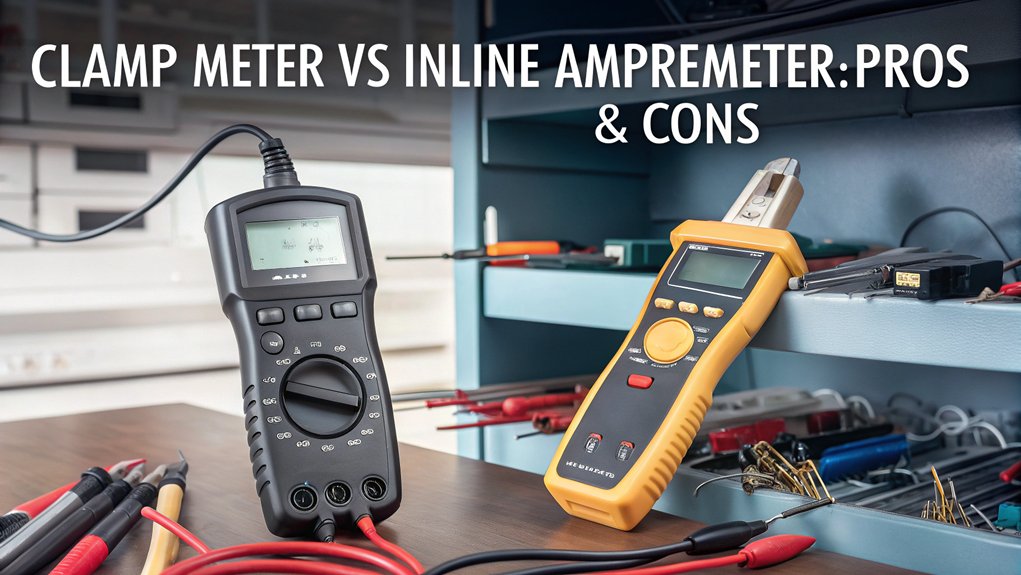
Choosing between a clamp meter and an inline ammeter requires understanding their unique strengths. Clamp meters offer non-invasive, quick setup, ideal for large conductors and live systems, but may lack precision in small currents. Inline ammeters provide high accuracy and reliable readings, suitable for demanding environments, yet involve complex installation and maintenance. Your choice will depend on balancing the need for convenience versus precision. There’s much more to uncover about each option for your specific needs.
TLDR
- Clamp meters offer non-invasive current measurement without circuit disruption, ideal for live systems and high-current tasks.
- Inline ammeters provide high accuracy in current measurement, suitable for demanding industries, but require circuit integration.
- Clamp meters are easy to use, quickly providing readings without wire disconnection, reducing downtime.
- Inline ammeters demand complex installation and maintenance, potentially increasing costs and requiring professional assistance.
- Clamp meters may lack accuracy for small currents, while inline ammeters ensure precise readings with minimal interference.
Understanding Clamp Meters
While exploring electrical diagnostics, understanding clamp meters is essential due to their unique ability to measure current without circuit disruption.
This meter type utilizes a clamp mechanism that surrounds the conductor, facilitating non-invasive flow measurement. You can access current readings without disconnecting wires, making it ideal for live systems.
Clamp meters are particularly advantageous for high current measurements, as they accommodate larger amperage compared to traditional methods. However, their accuracy can fluctuate based on the clamp’s calibration and conductor conditions, requiring regular validation.
Many clamp meters additionally offer functionalities like AC voltage and resistance measurement, enhancing their versatility.
When using a clamp to measure current, verify consistent testing to maintain precision and reliability in your electrical diagnostics.
Exploring Inline Ammeters
Inline ammeters offer a precise solution for current measurement by integrating directly within a circuit. Their direct contact with electrical current guarantees high accuracy measurements, essential for demanding industries like chemical and pharmaceutical.
However, this precision comes with installation complexity; you’ll need to cut and fit wires into the circuit, potentially causing downtime. This process often requires professional assistance, increasing upfront costs.
Additionally, the maintenance of inline ammeters is more intensive. Regular cleaning and calibration are necessary to maintain their accuracy over time. Despite their lower burden voltage, which minimizes measurement interference, the upkeep can be laborious.
Ultimately, inline ammeters provide reliable data but demand careful consideration of installation and maintenance commitments.
Key Advantages of Clamp Meters
After considering the complexities of inline ammeters, you’ll find clamp meters offer a different approach to current measurement. These meters provide non-invasive capabilities, letting you measure current without disturbing the circuit—ideal for swift troubleshooting in electronic work. The clamp-on flow meters are designed to fit large conductors and tight spaces, making them indispensable for electricians. They also boast a wide current measurement range, even up to several thousand amps, suitable for high-current tasks. Additionally, many models measure voltage, resistance, and continuity, providing versatility in testing scenarios. Quick setup and ease of use reduce downtime, as they don’t require wire disconnection.
| Feature | Benefit | Application |
|---|---|---|
| Non-invasive | No circuit interruption | Troubleshooting |
| Clamp design | Fits tight spaces | Cramped environments |
| Wide measurement | Handles high-current | Industrial use |
Potential Drawbacks of Clamp Meters
Although clamp meters offer convenience and versatility, they come with potential drawbacks that you should consider. One significant issue is their accuracy, especially when measuring small currents or irregular flow profiles. The burden voltage effect can increase wire impedance, leading to less accurate current readings under certain conditions.
Additionally, achieving stable zeroing in DC current mode can be challenging, affecting measurement reliability. As clamp meters measure current without direct electrical contact, precise shunt resistance consideration is often lacking.
Moreover, the performance of a clamp meter can vary based on the condition and material of the wire or pipe, resulting in potential inaccuracies.
- Lower accuracy in small or irregular currents.
- Difficulty with stable zeroing in DC current mode.
- Variability due to wire or pipe condition.
Benefits of Inline Ammeters
When accuracy is essential, inline ammeters excel due to their direct contact with the circuit, guaranteeing precise current measurements across varied applications. Their design prioritizes high accuracy and reliable readings, vital in industries like chemical and pharmaceutical sectors where precision is key. Inline ammeters offer minimal interference, thereby maintaining consistent current measurements without significant burden voltage effects. Built from robust materials, they withstand harsh environments, providing long-term durability.
| Feature | Benefit |
|---|---|
| High Accuracy | Guarantees precise current measurements |
| Minimal Interference | Delivers reliable readings consistently |
| Versatile Design | Supports shunt resistors and Hall effect sensors |
Despite requiring professional installation, their versatility accommodates various technologies, enhancing measurement capabilities. Inline ammeters’ reliable performance in demanding conditions makes them an industry favorite for critical applications.
Challenges of Using Inline Ammeters
Integrating inline ammeters into existing circuits presents several challenges that require careful consideration. First, installation necessitates cutting into circuits, which can lead to downtime and increased labor costs. This disruption might require temporary system shutdowns, impacting operations.
- Installation Complexity: Inline ammeters require precise fitting and may entail professional installation and system modifications, inflating upfront costs.
- Maintenance Demands: Regular cleaning and calibration are essential due to their direct contact with electrical circuits, adding to maintenance complexity.
- Measurement Inaccuracies: Without proper calibration and upkeep, these devices are prone to inaccurate readings, compromising reliability.
Addressing these challenges involves a strategic approach to installation and diligent maintenance practices to guarantee accurate and reliable current measurements.
Frequently Asked Questions
What Are the Disadvantages of Clamp Meter?
When using a clamp meter, you’ll face challenges like lower accuracy, especially with irregular flow conditions.
Its burden voltage effect can increase wire impedance, affecting AC measurement precision.
In DC mode, it struggles with stable zeroing, leading to unreliable readings if not properly zeroed.
Clamp meters require adjustments based on surface conditions and are less effective on small pipes, limiting their versatility in diverse environments and smaller systems.
What Are the Advantages of Clamp Meter Compared With Ammeter in Measuring Current?
You’ll find clamp meters advantageous because they offer non-invasive current measurement, which means you won’t need to break the circuit.
This feature enhances safety, especially in live systems. They’re quicker and easier to use, allowing you to measure current simply by clamping around a conductor.
Additionally, they provide a broader range for AC and DC measurements and usually maintain accuracy under various conditions with minimal setup, unlike in-line ammeters.
What Is the Difference Between an in Line Ammeter and a Clamp on Ammeter?
You’re exploring the difference between in-line and clamp-on ammeters.
An in-line ammeter integrates into the circuit, requiring you to interrupt the current flow for installation, offering higher accuracy.
In contrast, a clamp-on ammeter measures current by clamping around the conductor, allowing quick, non-invasive installation.
While clamp-on devices may sacrifice some accuracy, they offer lower maintenance and cost, making them suitable for temporary or portable applications without disrupting operations.
Are Clamp Amp Meters Accurate?
Clamp amp meters can be accurate, but you need to take into account factors like shunt resistance and burden voltage effects.
These can impact readings, especially in DC and higher current scenarios. While low-cost models might achieve good display accuracy, they often struggle with stable zeroing.
Typically, corrected accuracy values align with manufacturer specs, performing around 0.015% or better under ideal conditions.
Always verify your meter’s calibrated to maintain precision in your measurements.
Conclusion
When choosing between a clamp meter and an inline ammeter, think of it as selecting the right tool from a craftsman’s toolbox. Clamp meters offer convenience and safety, letting you measure current without breaking the circuit. However, their accuracy can sometimes waver. Inline ammeters provide precise readings but require circuit interruption, which can be cumbersome. Weighing these pros and cons carefully will guarantee you pick the right instrument for your electrical measurement needs.