
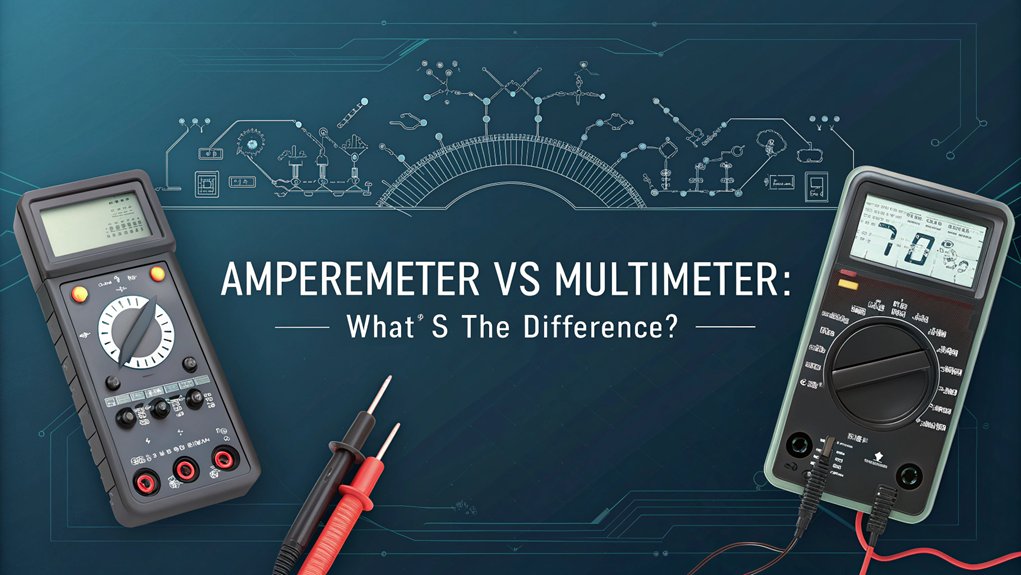

An amperemeter measures current exclusively, requiring a series connection for accurate readings, while a multimeter provides a multifaceted approach, measuring current, voltage, and resistance across series or parallel configurations. With multimeters, you’re equipped for diverse diagnostics, including diode and transistor checks. Though multimeters are pricier, offering more functions, the amperemeter excels in precise current monitoring. Your choice hinges on specific measurement needs and budget. Explore further to enhance understanding and find the perfect tool for your tasks.
TLDR
- Amperemeters measure only current, while multimeters measure current, voltage, and resistance.
- Amperemeters connect in series; multimeters can connect in series or parallel.
- Multimeters offer additional functions like diode and transistor testing.
- Amperemeters are generally less expensive compared to multifunctional multimeters.
- Multimeters provide digital display features for enhanced readability and accuracy.
Understanding the Amperemeter
An ammeter is a critical tool for anyone working with electrical circuits, as it measures the electric current flowing through the circuit in units such as amperes (A), milliamperes (mA), or microamperes (µA).
To measure current accurately, you must connect the ammeter in series with the circuit, guaranteeing the electric current flows through the device. This setup, combined with the ammeter’s low internal resistance, minimizes voltage drop, allowing for precise readings.
Digital ammeters offer enhanced accuracy and readability, displaying measurements clearly on a digital screen. Additionally, specialized versions like clamp meters provide the convenience of measuring current without circuit disconnection, beneficial in various applications.
Understanding these features guarantees you use the ammeter effectively in your electrical projects.
Functions of a Multimeter
While working with electrical systems, the multimeter stands out as an indispensable tool due to its multifunctionality. A digital multimeter (DMM) is capable of measuring multiple electrical properties, including current, voltage, and resistance.
Its capacity to test diodes and transistors enhances its utility in electronic diagnostics, offering functionality that ammeters simply don’t provide. With different measurement modes, you can seamlessly switch between measuring current in series or voltage and resistance in parallel as needed.
Advanced models go further, measuring continuity, capacitance, and duty cycle, thereby broadening diagnostic capabilities. Additionally, a DMM often features a digital display and hold functions, ensuring easier reading and recording of measurements, even in challenging lighting conditions.
This versatility makes it essential for precise electrical assessments.
Key Differences Between Amperemeters and Multimeters
Understanding the distinctions between amperemeters and multimeters is critical when selecting the right tool for your electrical tasks. An amperemeter focuses solely on measuring current in amperes (A) and must be connected in series within an electrical circuit for accuracy.
In contrast, a multimeter offers versatility, measuring current, voltage, and resistance, making it a valuable tool for various applications.
Consider these key differences:
- Functionality: Amperemeter measures current only; multimeter measures current, voltage, and resistance.
- Connection: Amperemeter connects in series; multimeter adapts to series or parallel, depending on the measurement type.
- Cost: Amperemeters are generally less expensive; multimeters cost more due to multifunctionality.
- Scope: Amperemeter has a narrower focus; multimeter performs additional tests, like diode and transistor checks.
These distinctions guide your decision-making process.
Applications of Amperemeters
If you’re tackling electrical diagnostics, amperemeters are indispensable tools for pinpointing current-related issues. They’re specifically designed to measure electrical current, providing precise readings in amperes, milliamperes, or microamperes. You must connect them in series with circuit components to guarantee accuracy without disrupting the circuit’s operation. These applications are vital in industrial settings, research labs, and electrical maintenance, where monitoring current draw in motors and transformers is essential. Advanced models, like clamp meters, offer non-intrusive current measurements, enhancing safety and convenience. Detecting unexpected current levels can indicate system faults or inefficiencies, aiding in effective troubleshooting.
| Application | Benefit |
|---|---|
| Industrial Settings | Monitor current draw in motors |
| Research Laboratories | Accurate current measurements |
| Electrical Maintenance | Diagnose system faults |
| Advanced Models | Non-intrusive measurements |
Versatility of Multimeters
Although traditional ammeters focus solely on current measurements, multimeters offer a significant advantage with their ability to measure multiple electrical properties, including voltage, current, and resistance.
By using a digital multimeter (DMM), you gain access to a versatile tool necessary in electronics. You can measure potential difference with precision and switch seamlessly between measurement modes.
The multimeter’s wide range of functionalities includes:
- Continuity testing: Detects broken circuits and verifies connections are intact.
- Capacitance measurement: Evaluates capacitors’ storage ability, essential for circuit design.
- Duty cycle analysis: Assesses the fraction of time a system is active, critical for pulse-width modulated signals.
- Dual AC/DC current measurement: Offers flexibility not found in traditional ammeters.
Multimeters are indispensable for troubleshooting and diagnostics, providing thorough insights into electronic systems.
Cost Considerations
When considering the cost of measurement tools, it’s crucial to evaluate the specific needs of your projects and the functionality required.
Ammeters, focused solely on current measurement, generally offer a lower price range, making them budget-friendly for users primarily needing current measurements.
In contrast, digital multimeters (DMMs) provide multi-functional capabilities, reflected in their higher price range, starting from around $20 and going up to several hundred dollars. This price variation in multimeters is due to their ability to measure various parameters such as voltage, current, and resistance, adding versatility.
Cost considerations become pivotal when determining whether the added features of a DMM justify its cost.
Higher-end multimeters include advanced functionalities, greatly increasing their cost compared to basic ammeters, impacting your overall budget decisions.
Choosing the Right Tool for Your Needs
How do you determine the right tool for your electrical measurement needs? Consider your specific requirements.
An ammeter is perfect if you need to measure electric current exclusively and want a cost-effective solution. However, a multimeter offers more versatility by allowing you to measure voltage, current, and resistance in one device.
Here’s what to think about:
- Task scope: Are you measuring just current or multiple parameters?
- Functionality: Do you need to test diodes or transistors?
- Precision: A digital multimeter can accurately measure low currents down to microamperes.
- Budget: Ammeters are generally less expensive but less versatile.
A multimeter is an ideal choice for all-encompassing diagnostics, saving you time and space by replacing separate instruments.
Enhancing Measurement Accuracy
Selecting the right tool is just the first step; ensuring measurement accuracy is equally important. A digital multimeter (DMM) considerably enhances measurement accuracy by allowing seamless switching between measuring voltage and current.
Its high internal resistance minimizes circuit interference, ensuring precise voltage readings. For current measurements, it accurately captures the flow of current without impacting the circuit’s operation.
Advanced DMMs with auto-ranging capabilities automatically select the best range, further enhancing precision. Additionally, the integration of functions like continuity and diode testing aids in troubleshooting, providing thorough insights into complex circuits.
Frequently Asked Questions
Is an Amp Meter the Same as a Multimeter?
You might wonder if an amp meter is the same as a multimeter, but they’re distinct tools.
An amp meter measures only current, requiring series connection in circuits. In contrast, a multimeter measures current, voltage, and resistance, offering versatility.
It can connect in series or parallel depending on the measurement. While an amp meter focuses solely on current, a multimeter’s multifunctionality makes it indispensable for broader electrical diagnostics.
Can I Measure Amps With a Multimeter?
Yes, you can measure amps with a multimeter.
First, select the appropriate current range setting to avoid damaging the device. Plug the test leads into the correct ports, typically the “A” port for current measurements.
Break the circuit and insert the multimeter in series to guarantee accurate readings. Remember, current must flow through the multimeter, so precise setup is essential for an exact measurement.
This approach offers versatility in electrical diagnostics.
What Is the Difference Between Ammeter and Digital Multimeter?
Did you know that 80% of electricians prefer digital multimeters for their versatility?
When you compare an ammeter to a digital multimeter, you’ll see that an ammeter measures only current, while a multimeter measures current, voltage, and resistance.
Ammeters connect in series, essential for accurate current readings, whereas multimeters can connect in parallel or series.
This makes multimeters more expensive but invaluable for thorough diagnostics, offering features like continuity and capacitance tests.
What Is the Main Difference Between an Ammeter and a Voltmeter?
You’re looking at two different tools here. An ammeter measures the electric current flowing through a circuit in amperes, and you’ve got to connect it in series.
On the other hand, a voltmeter gauges the voltage difference between two points and requires a parallel connection.
Ammeter’s low internal resistance is key for accurate current measurement, while a voltmeter’s high resistance guarantees it doesn’t disrupt the circuit’s current flow.
Conclusion
So, you’ve stumbled upon the world of amperemeters and multimeters. Coincidence? Maybe not. While amperemeters specialize in measuring current, multimeters offer a multifaceted approach, measuring voltage, resistance, and more. This versatility makes multimeters invaluable for diverse tasks. When selecting your tool, consider your specific needs and budget. Remember, precise measurements hinge on choosing the right instrument. By understanding their differences, you’ll enhance your measurement accuracy and become more adept in tackling electrical challenges.